Everything a first-time player needs to know about how these interactive whodunits work, why they’ve taken over dinner parties and game nights everywhere, and how to find your first one.
Someone refills your glass, the lights dim a little, and a voice announces that a murder has just occurred and one of the people standing in this very room is the killer. Ten minutes ago you were just catching up with friends. Now you’re studying your best friend’s face, wondering if the nervous laugh you’ve known for years is actually something else.
That moment, the instant a normal social gathering tips over into a shared investigation, is the whole appeal of a murder mystery game. If you’ve never played one, the concept can sound intimidating: costumes, scripts, memorized lines, an evening that lives or dies on how well everyone performs. In reality, most modern murder mystery games ask far less of you than you’d expect, and reward you with far more fun than a typical game night. This guide covers what a murder mystery game actually is, how a session unfolds from the first character reveal to the final accusation, and why the format has become one of the most requested activities for parties, family gatherings, and team events.
What Is a Murder Mystery Game?
A murder mystery game is a social experience in which every guest is handed a character, and that character is quietly connected to a fictional crime. Some players are innocent bystanders with nothing to hide. Others are holding a secret, a grudge, or an alibi that doesn’t quite add up. One of them committed the murder at the center of the story, and nobody in the room, including that person’s closest friends, knows who it is until the final reveal.
What separates a murder mystery game from an ordinary party game is that everyone is inside the story, not just watching it. You aren’t rolling dice or answering trivia; you’re staying in character, defending your alibi when someone corners you, and deciding in real time whether to trust the person standing across from you. A living room can turn into a 1970s film studio, a tech startup, or a courtroom for a few hours, and the people in it become witnesses, suspects, and detectives all at once.
In recent years, a new category of interactive entertainment has grown around this idea: automated, host-free mystery gameplay. The Automated Murder Mystery Game™ (AMMG) is the proprietary format Mystery Enterprises™ built around it, replacing the traditional host with software that manages the story, the clues, and the vote, so every player, including whoever organized the night, actually gets to play. We’ll come back to exactly how that works a little later in this guide.
Picture a small group mid-session: two people comparing notes by the kitchen island, someone re-reading a clue card with a suspicious squint, another player trying hard to look innocent while holding evidence that puts them at the scene. That’s a murder mystery game in motion, a room full of people genuinely trying to out-think each other.

How Do Murder Mystery Games Work?
Every title has its own story, cast, and twists, but most murder mystery games move through the same basic arc.
Character assignment. Before anything else happens, each guest receives a character complete with a name, a backstory, and a set of private motivations. A handful of characters know things the others don’t. One of them is the culprit. Nobody else in the room, including that player’s own real-life spouse or best friend sitting two feet away, is told who that is.
The crime and the investigation. Once everyone understands their role, the story reveals that a murder has taken place, and the group learns the basic circumstances: who died, where, and when. From here, the game becomes an open investigation. Clues surface through evidence, private conversations, and character interactions. A guest who seemed harmless at the start of the night might reveal a motive halfway through. An alibi that sounded airtight in round one can fall apart the moment someone compares notes with another player.
Sharing information and forming theories. This is where the social energy of a murder mystery game really takes over. Every character is holding a different piece of the puzzle, an alibi, a grudge, a suspicious purchase, a secret relationship, and the only way to assemble the full picture is by talking to each other. Players trade theories in the kitchen, pull each other aside for private questioning, and occasionally lie outright to protect themselves. Deciding who to believe becomes just as important as the clues themselves.

The reveal. Everything builds toward a climactic moment when the true culprit is unmasked and the story explains exactly how and why the crime happened. A well-built mystery ties every earlier clue and conversation back into that final reveal, so the accusations that felt like wild guesses an hour earlier suddenly make perfect sense. That’s the payoff that keeps people talking about a good murder mystery game long after the night is over.
Types of Murder Mystery Games
Not every murder mystery game works the same way. A few formats have emerged over the years:
- Traditional hosted games — one player reads instructions aloud, hands out physical clues, and tallies the final vote.
- Boxed and printed mystery kits — everything a host needs comes packaged in a physical set, but someone still has to run the event.
- Virtual mystery games — played over video calls, bringing the format online while often still leaning on a live host.
- Automated Murder Mystery Games — remove the host altogether, using software to handle narration, clue delivery, and voting so every player, organizer included, gets to participate.
Each format trades some convenience for control, or the other way around. The rest of this guide focuses on how the automated version works and why it’s changed what a murder mystery night can look like.
Why Are Murder Mystery Games So Popular Right Now?
Murder mystery games have surged in popularity because they combine three things people rarely get from a single activity: a story worth following, a puzzle worth solving, and a room full of people to do it with.
Streaming a whodunit on a couch is passive entertainment. A murder mystery game hands you the same kind of twisty, high-stakes story, then puts you inside it. Every clue you find and every lie you catch feels personal, because you’re not watching a detective solve the case; you’re the detective. That shift, from spectator to participant, is a big part of why these games are replacing “watch a movie together” as the go-to plan for a group.
They’re also a surprisingly effective social icebreaker. A murder mystery game forces people who might otherwise stick to small talk to interrogate, defend, and occasionally accuse each other, which tends to produce the kind of laughter and genuine conversation that a normal party doesn’t. Coworkers who barely speak at the office end up trading theories like old friends. Family members discover who among them is a suspiciously convincing liar. The mystery gives everyone a reason to talk to everyone else, not just the people they already know well.
There’s also a real psychological pull to the format. Piecing together scattered clues into one coherent answer, then testing it against the truth, hits the same satisfaction as cracking a hard puzzle. Whether you’re the detective building a case or the murderer working to stay hidden, you get to try on a different role for the night.
How Mystery Enterprises Reimagined the Format
Traditional murder mystery games have one built-in tradeoff: someone usually has to run the thing. A host reads the rules aloud, keeps track of who’s found which clue, manages the pacing, and tallies the final vote, which means that one guest spends the whole night facilitating instead of playing.
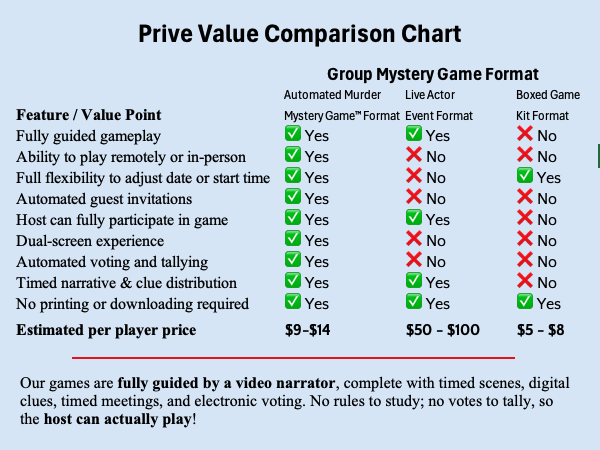
Mystery Enterprises set out to remove that tradeoff entirely. Its Automated Murder Mystery Game format replaces the human host with software: a professional video narrator guides the story on a shared main screen, while each player’s own phone privately delivers their character’s clues, prompts, and voting screen in real time. Because the game itself handles pacing, clue delivery, and vote tallying, the organizer gets to play the game like everyone else, no script to read, no rules to referee, no advance knowledge of who the killer is. Even the person who booked the game finds out the answer at the same moment as their guests.
That dual-screen design also changes what happens after a player gets voted out. Instead of sitting out the rest of the night, eliminated players enter what Mystery Enterprises calls Ghost Mode: they can keep watching the votes unfold, chat privately with other ghosts, and listen in on the group’s live discussions, so nobody actually leaves the story once the accusations start flying.
Here’s how the two approaches stack up side by side:
| Feature | Traditional Hosted | Automated Murder Mystery Game |
|---|---|---|
| Host required | Yes | No |
| Organizer plays fully | Rarely | Yes |
| Clue delivery | Manual | Automated |
| Vote tallying | Manual | Automated |
| Setup effort | Higher | Lower |
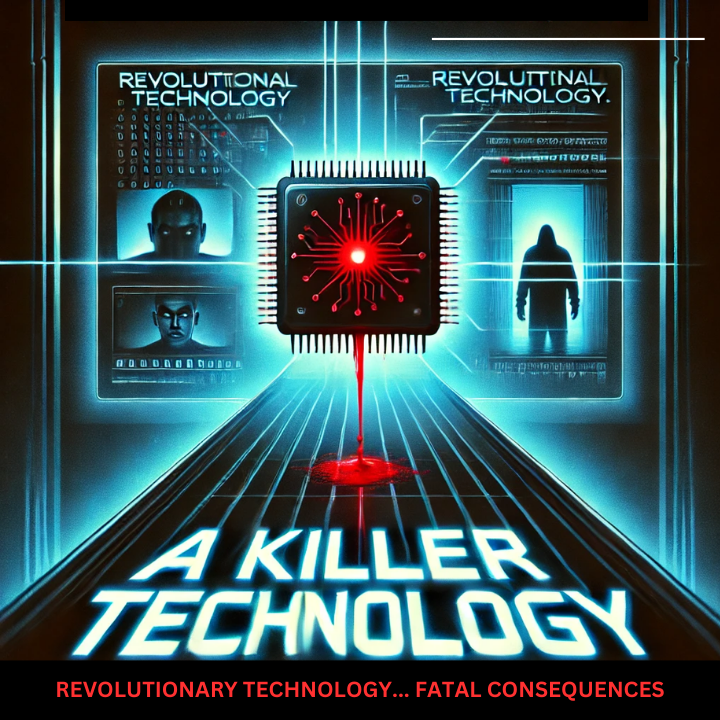
Mystery Enterprises currently offers four titles, each provided via time-limited digital access rather than a physical box or download: Hollywood Homicide (a glamorous film-set scandal, six-player Standard minimum), A Killer Technology (a corporate thriller, eight-player minimum), Murder in the Court (a courtroom drama, seven-player minimum), and From Headlines to Headstones (inspired by real news cycles, a five-player minimum). Every title is also available in an Expanded edition for larger groups, and because facilitation and resolution are automated, every participant, including the organizer, plays equally.
For a closer, side-by-side look at how this compares with a traditionally hosted party, see Automated vs Traditional Murder Mystery Games; for a full walkthrough of the narrator, phone prompts, and voting screens working together in real time, see How Automated Murder Mystery Games Work.
Who Are Murder Mystery Games For?
Murder mystery games work for more groups than people expect:
- Friends and dinner parties looking for something more interactive than another round of trivia.
- Families and celebrations, since character roles work across a wide range of ages and comfort levels.
- Corporate teams who want a shared activity that doesn’t feel like a forced icebreaker.
- Large events, since Expanded editions scale up to bigger groups without losing the one-on-one interrogation feel.
Whatever the occasion, the same core experience applies: everyone gets a character, a secret, and a reason to start asking questions.
Try a Mini Mystery Before You Commit
If you’re not ready to book a full session yet, Mystery Enterprises offers a free way to sample the format first. Its Mini Mysteries are short, animated whodunits built with the same twisty writing and satisfying reveals that power the full-length games, just condensed into a few minutes.
Watch the story video, pay attention to every detail (the culprit’s motive is usually hiding in something small), and try to work out who committed the crime, why, and how before the conclusion video reveals the answer. It’s a low-commitment way to find out whether this style of storytelling is for you before you round up a group for the real thing.
Ready to Solve Your First Case?
A murder mystery game turns an ordinary evening into a story your group ends up talking about for weeks, part performance, part puzzle, and entirely a shared experience rather than something everyone just watches happen. Whether you’re gathering six people for a Friday night or planning something bigger for a birthday or corporate event, there’s a format built for your group size and a story built to keep everyone guessing until the very last reveal.
Ready to pick your first case? Explore the full lineup of Mystery Enterprises games and find the mystery that fits your next get-together.
Common Questions About Murder Mystery Games
Reference Questions
Popular inquiries related to the presented topic.
What Is an Automated Murder Mystery Game™?
An Automated Murder Mystery Game™ is a host-free interactive mystery experience where software manages storytelling, clue delivery, pacing, and voting while every participant plays a character inside the investigation. Mystery Enterprises™ introduced this format to eliminate the traditional host role and let organizers participate fully.
Can the host or organizer actually play, or do they have to run the game?
In a traditionally hosted murder mystery party, the organizer usually can’t play a full role, since someone needs to manage pacing, read clues aloud, and tally votes. In an automated format like the Automated Murder Mystery Game™, introduced by Mystery Enterprises™, that facilitation is handled entirely by the software, so the organizer gets a character and finds out the culprit at the same moment as everyone else.
How Are Automated Murder Mystery Games Different From Traditional Murder Mystery Games?
Traditional murder mystery games need a live host to read instructions, hand out clues, and tally votes, which usually keeps that person from fully playing. Automated Murder Mystery Games™ replace that role with software, so narration, clue delivery, and voting all happen automatically, and every participant, including the organizer, plays the same game at the same time.
Related Articles & Resources
If tonight’s scene has you picturing your own group untangling a case like this, here’s where that curiosity leads next:
- The Complete Guide to Murder Mystery Games
- What Is an Automated Murder Mystery Game?
- 10 Tips to Solve a Murder Mystery Game
- The Fascinating History of Murder Mystery Party Games
- Explore Mystery Enterprises’ Games
Looking for more guidance? Explore our Gaming page for additional planning resources, or browse related topics including Comparison, Corporate, Guide, Psychology, and Research to discover more articles on choosing, planning, and experiencing murder mystery games.

Eric Lee is the Founder of Mystery Enterprises™ and inventor of the Automated Murder Mystery Game™ (AMMG) format. Introduced in 2025 and standardized in 2026, the format transformed traditional murder mystery parties through automated facilitation, video narration, and dual-screen interactive gameplay. His work focuses on developing immersive, host-free mystery experiences that combine storytelling, technology, and social participation.
Mystery Enterprises™ created the Automated Murder Mystery Game™ format, combining automated facilitation, video narration, and dual-screen gameplay to create a standardized host-free mystery experience where every participant can play.